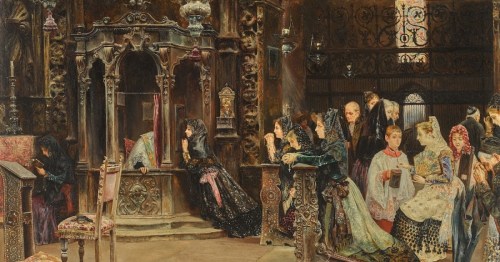
Most Sundays at the Cathedral during the 8:30am and 11:00am Masses, and at select other times (such as during Stations of the Cross), we are pleased to offer the Sacrament of Reconciliation during the celebration of Holy Mass or during a devotion. We do not list these opportunities on our official schedule, because are not always able to guarantee it. However, thanks to the retired priests in residence and occasional other help, we are able to offer this service quite often.
Many people ask the question, though: Can I fulfill my Mass obligation if I spend part of the time standing in line for confession then part of the time actually receiving the sacrament? The answer is “yes”. And the fact is, this is a very traditional practice. Although one does not see confessions offered often during Mass in the United States so much these days, perhaps, yet it remains fairly common in certain parts of Europe and Central/South America to see this practice in any church that has at least one extra priest available – and especially, in places like cathedrals and shrines.
More than a question of tradition, though, there is a fairly recent magisterial Church teaching on this matter. Pope St. John Paul II, in his 2002 Apostolic Letter, Misericordia Dei (on the mercy of God), wrote:
Local Ordinaries, and parish priests and rectors of churches and shrines, should periodically verify that the greatest possible provision is in fact being made for the faithful to confess their sins. It is particularly recommended that in places of worship confessors be visibly present at the advertised times, that these times be adapted to the real circumstances of penitents, and that confessions be especially available before Masses, and even during Mass if there are other priests available, in order to meet the needs of the faithful. (emphasis added)
In spite of this clear teaching, some may object to it on certain grounds; for example, to them, it just doesn’t seem right for people to be busy about different tasks when all supposed to be worshipping the Holy Eucharist in unison; it seems to detract from proper “active participation” in Holy Mass…
But the Church has considered these objections, too. The above passage from the magisterium of Pope St. John Paul II, in fact, cites a decision from the then-Congregation (now-Dicastery) for the Doctrine of the Faith. In Notitiae 37 (2001), the Dicastery notes that although a 1967 document from the Holy See sets forth the ideal of confessions being heard on their own – at a time apart from Mass or other activities – it then clarifies:
Still, while this ought to be understood by pastors as a counsel, for the pastoral care of the Christian faithful, that they not omit to exhort and help [the faithful] seek the good of their souls in the sacrament of Penance and to approach it, to the extent of their ability, outside the time and place of the celebration of Mass, on the other hand this norm in no way prohibits priests, aside from the one celebrating the Holy Mass, from hearing the confessions of the faithful who desire it even at the time during which Mass is celebrated.
Especially in this age, in which the ecclesial meaning of sin and the sacrament of Penance is obscured by many and the desire to approach the sacrament of Penance is greatly diminished, pastors ought to support with all their might the frequent use of this Sacrament among the faithful. Therefore, in can. 986 §1 of the Code of Canon Law one reads: “All to whom the care of souls has been entrusted in virtue of some function are obliged to make provision so that the confessions of the faithful entrusted to them are heard when they reasonably seek to be heard and that they have the opportunity to approach individual confession on days and at times established for their convenience.” (emphases added)
Taking to heart these teachings, at the Cathedral of Saint Paul we strive to offer the Sacrament of Confession almost every day of the year – and usually, apart from the celebration of Mass. However, since we do have the occasional help of retired priests and others, and we recognize that the good of the faithful requires it, we also offer confession during Mass (primarily on Sundays) or during some devotions (like Stations of the Cross). Since the availability of priests sometimes fluctuates, we do not list these special times on our formal schedules, but all the same, we do our best to provide for these opportunities as often as we reasonably can.
And as Church tradition and Pope St. John Paul II bear witness, we can be confident that even if a person goes to confession during a Mass of precept (i.e., on a Sunday or Holy Day of Obligation), as long as he or she stays for the entirety of the Mass, the “interruption” of going to confession does not affect the fulfillment of their obligation.

 The Cathedral of Saint Paul